
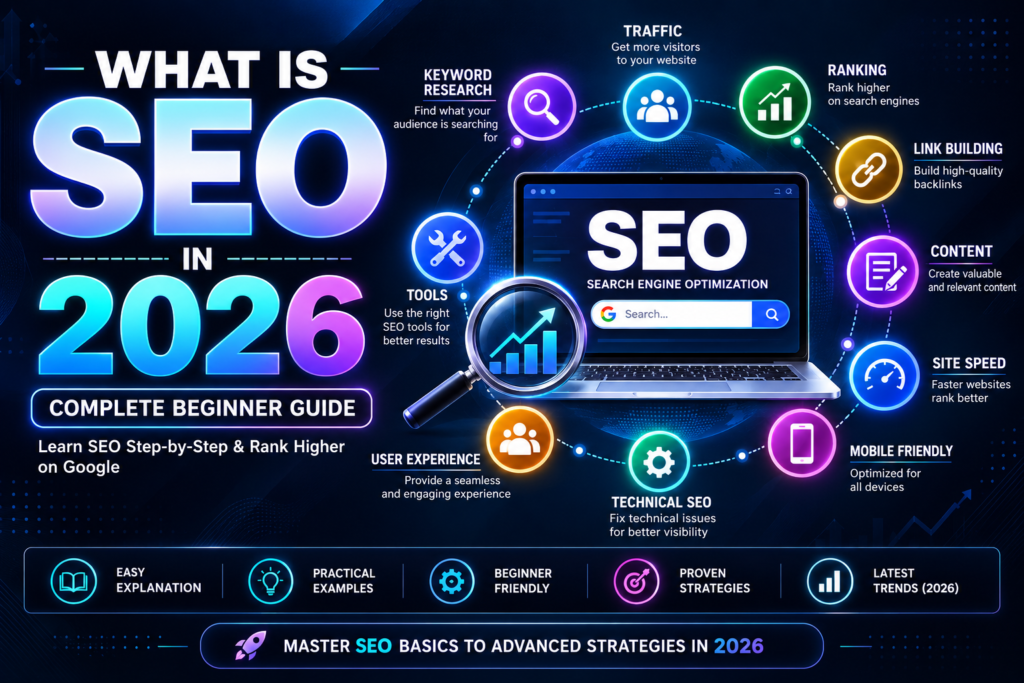
If you have ever wondered what is SEO and why every online business keeps talking about it, you are in the right place. Imagine Google as the world’s largest digital library. Millions of people walk into this library every day asking questions, searching for products, or looking for local services. Search Engine Optimization—commonly known as SEO—is simply the process of making sure your website becomes the top book the librarian hands over.
In simple terms, what is SEO? Search Engine Optimization is the practice of organizing, writing, and improving your website so search engines like Google, Bing, and AI search tools can easily find, understand, and show your content to real users.
Whether you are running a local business, starting a blog, or building an online store, understanding what is SEO is your secret weapon for getting free, steady website traffic without paying for ads.
Table of Contents
Why is Search Engine Optimization Important?
Now that you know what is SEO, let’s look at why it plays such a critical role in online success.
When people need answers, they turn to search engines. If your website appears at the very top of those search results, users naturally click on your link. Here is why businesses depend on SEO:
- Brings Free Organic Traffic: Unlike paid advertisements that stop sending visitors the moment you stop paying, organic search results keep bringing people to your site long-term.
- Builds Trust and Credibility: People trust Google. When Google ranks your site on page one, users automatically view your business as reliable and authoritative.
- Reaches High-Intent Customers: SEO puts your content in front of users at the exact moment they are looking for what you offer, making them much more likely to take action.
- Improves User Experience: Modern SEO forces you to build fast, clean, and mobile-friendly websites, which keeps your visitors happy.
How Do Search Engines Work? (Crawling, Indexing, and Ranking)
To fully grasp what is SEO, you must first understand what search engines do behind the scenes. The whole process happens in three core steps:
- Crawling: Search engines send out automated programs (often called bots or spiders) to discover new and updated pages on the web by following links.
- Indexing: Once a bot finds a page, it analyzes the content, images, and structure, then stores that information in a massive digital database known as the index.
- Ranking: When a user types a search query, Google searches its index and orders the best matching pages based on relevance, quality, speed, and trust factors.
The Core Types of SEO
Search engine optimization is not just a single task; it is a collection of strategies working together. The three main pillars include:
1. On-Page SEO
On-Page SEO involves optimizing the elements directly on your website pages. This helps search engines read your content and recognize its topic.
- Title Tags & Meta Descriptions: Crafting compelling titles and summaries that encourage users to click.
- Header Tags (H1, H2, H3): Structuring your content clearly for easy reading.
- Content Quality: Writing helpful, accurate, and easy-to-read articles that solve user problems.
- Internal Links: Connecting related pages on your website so users and search bots can navigate easily. (Learn more about how to structure your site in our guide on website navigation best practices).
2. Off-Page SEO
Off-Page SEO focuses on actions taken outside of your website to build its overall reputation and authority.
- Backlinks: Earning links from other respected websites, which act like digital “votes of confidence.”
- Brand Mentions & PR: Getting your brand talked about across news sites, blogs, and social platforms. (If you want to grow your audience across social networks, check out our beginner’s guide on social media marketing strategies).
3. Technical SEO
Technical SEO ensures that search engines can easily access, crawl, and store your website without technical glitches.
- Page Speed: Ensuring your site loads in under three seconds.
- Mobile-Friendliness: Making sure your site works smoothly on smartphones and tablets.
- Security (HTTPS): Protecting user data with secure SSL encryption.
Understanding Keywords and Search Intent
At the heart of every SEO strategy are keywords—the actual words and phrases people type into search bars.
To succeed with keywords, you must understand Search Intent (the hidden reason behind a user’s search). Search intent generally falls into four simple buckets:
| Search Intent Type | What the User Wants | Example Search Query |
| Informational | To learn about a topic | “What is SEO and how does it work?” |
| Navigational | To find a specific website | “Google Search Console login” |
| Commercial | To research options before buying | “Best SEO tools for small business” |
| Transactional | To take action or make a purchase | “Buy SEO course online” |
Always align your content directly with what the searcher is hoping to find!
What is Local SEO and Answer Engine Optimization (AEO)?
As search technology evolves, SEO expands into new areas:
- Local SEO: Helps physical businesses (like clinics, institutes, or restaurants) rank in local map searches. If someone searches for a service “near me,” Local SEO helps your Google Business Profile show up first.
- Answer Engine Optimization (AEO): Focuses on optimizing your content for direct answers delivered by modern AI search engines like Google AI Overviews, ChatGPT Search, and Gemini. Keep your answers clear, accurate, and structured so AI platforms can easily feature your content.
Top Free SEO Tools for Beginners
You don’t need a huge budget to start optimizing your website. Here are essential free tools every beginner should use:
- Google Search Console: Monitors your site’s performance on Google, tracks search keywords, and reports indexing issues.
- Google Analytics 4 (GA4): Helps you track how many people visit your site and what pages they read.
- Google Keyword Planner: Assists in finding popular search terms related to your topic.
Frequently Asked Questions (FAQs)
What is SEO in simple terms?
In simple terms, what is SEO refers to the process of improving your website so search engines like Google can rank your pages higher in free, organic search results.
How long does SEO take to show results?
SEO is a long-term strategy. While some small technical changes can show progress in a few weeks, consistent ranking improvements typically take between 3 and 6 months.
Is SEO free to use?
Yes, organic search engine rankings are completely free. You do not pay Google when someone clicks on your organic search result, unlike paid search advertisements.
Can I learn SEO on my own without technical skills?
Absolutely. Anyone can learn the basics of what is SEO, including content creation, basic keyword research, and simple on-page tweaks, without needing advanced coding skills.