
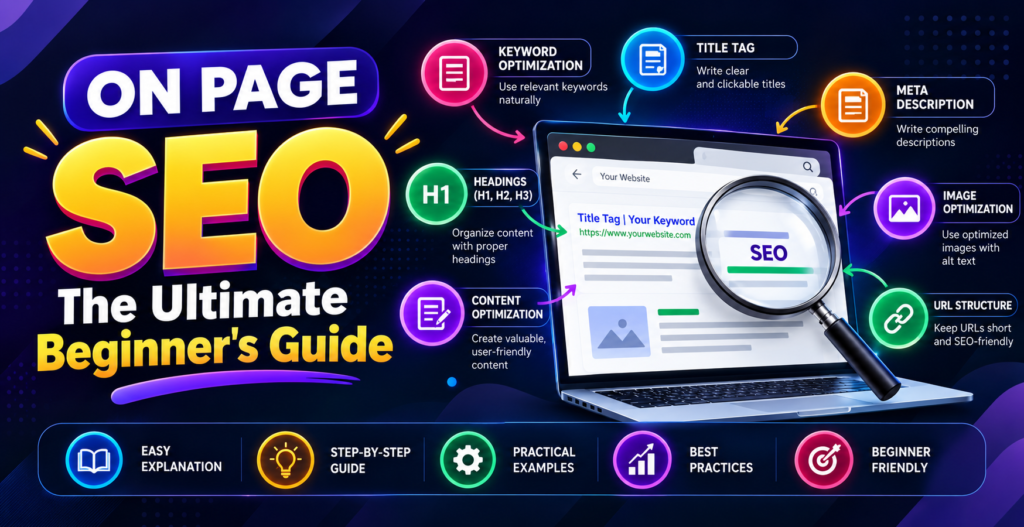
If you want your website to attract steady organic traffic from Google, mastering On-Page SEO is the best place to start. Picture your website as a physical store in a massive shopping mall. If the shop windows are cluttered, the signs are missing, and products are scattered randomly, shoppers will simply walk past. On-Page SEO is the process of setting up your store clean, organized, and easy to navigate so both customers and search engine bots immediately understand what you sell.
In short, On-Page SEO covers every tweak, optimization, and content adjustment you perform directly on your web pages to secure higher rankings on search engine results pages.
While earning authority signals like backlinks takes time, executing solid On-Page SEO guarantees that your content answers searchers’ questions clearly. Whether you manage a personal blog, an e-commerce storefront, or a corporate portal, understanding On-Page SEO allows you to capture steady, unpaid web traffic day after day.
Why is On-Page SEO Important for Beginners?
Focusing on On-Page SEO helps you match your website’s content with the exact terms people search for online. Here is why applying proper On-Page SEO is vital for expanding your online audience:
- Guides Search Engine Crawlers: Search bots process text differently than people do. Proper On-Page SEO provides clear structural signals so crawlers understand your core subject.
- Fulfills User Intent: Fine-tuning your pages ensures your articles provide direct, satisfying solutions to the specific queries users type into search bars.
- Boosts Search Click Rates: Crafting compelling title tags and short summary snippets prompts more users to choose your link over competitors.
- Enhances Reading Experience: Formatting articles with short paragraphs and clear section headings keeps visitors on your site longer.
The Core Elements of On-Page SEO
Building a fully optimized web page requires paying attention to a few foundational components. Here is a breakdown of the key factors that drive successful On-Page SEO:
1. Title Tags and Meta Descriptions
Your page title serves as the main clickable headline in search engines, while the meta description acts as the small preview paragraph underneath.
- Position Primary Terms Early: Place your main target term toward the front of your page title.
- Respect Character Limits: Aim for titles under 60 characters and descriptions under 160 characters so search engines do not trim your text.
- Write Inviting Copy: Draft clear, value-focused previews that motivate readers to visit your site.
2. Strategic Keyword Placement
Effective term placement means highlighting key topics without repeating words awkwardly.
- Introduce your primary target phrase within the opening 100 words of your article.
- Integrate main and related search phrases naturally inside your section subheadings (H2, H3).
- Prioritize natural readability over keyword count; always write for real human readers first.
3. Logical Structure and Heading Tags
Header tags (H1, H2, H3) serve as structural guideposts across your web page.
- H1 Header: Assign a single H1 tag per page for your main headline.
- H2 & H3 Headers: Use H2 tags to introduce main subtopics and H3 tags to break down smaller details, making the article easy to skim.
4. Internal Link Integration
Internal links guide visitors from one page on your domain to another relevant page.
- They allow users to discover related articles on your site effortlessly.
- They assist web crawlers in indexing new pages across your site structure. (To understand search engine fundamentals, read our beginner guide on what is SEO and how it works).
5. Image Optimization and Alt Text
Search bots cannot view visual content the same way human eyes do.
- Clear File Names: Label your raw image files using descriptive titles (e.g., on-page-seo-guide-diagram.jpg).
- Descriptive Alt Tags: Add short text summaries to every visual asset to assist screen-reading software and help search engine algorithms index your media.
On-Page SEO vs. Off-Page SEO vs. Technical SEO
To see how the big picture comes together, compare these three fundamental branches of search engine optimization:
| SEO Category | Primary Focus | Practical Example |
| On-Page SEO | Fine-tuning content directly on your website pages | Writing clear titles, headers, and image alt descriptions |
| Off-Page SEO | Building authority and trust across external websites | Securing editorial mentions and external links (Discover more in our breakdown of social media marketing strategies) |
| Technical SEO | Enhancing site speed, mobile setup, and security | Installing SSL certificates (HTTPS) and speeding up load times |
Simple Step-by-Step On-Page SEO Checklist
Before launching a new piece of content, run through this practical On-Page SEO checklist:
- Verify Key Terms: Is your primary focus keyword placed in your H1 headline, page URL, and intro paragraph?
- Organize Subheadings: Have you separated long text blocks using clear H2 and H3 section breaks?
- Format Media Files: Are your image sizes compressed for fast loading, and do they include descriptive alt text?
- Insert Internal Links: Have you linked to at least 2 or 3 other relevant posts on your domain?
- Add Trusted External Links: Did you reference reputable third-party sources where appropriate?
- Test Mobile Readability: Does your layout display cleanly across smartphones and tablet screens?
Frequently Asked Questions (FAQs)
What is On-Page SEO in simple terms?
On-Page SEO is the process of structuring text, titles, headings, and images directly on your web pages so search engines can rank your content higher.
How is On-Page SEO different from Off-Page SEO?
On-Page SEO focuses on optimizations you control directly on your site, whereas Off-Page SEO involves external credibility signals like earning backlinks from other websites.
How many times should I use my target phrase for On-Page SEO?
For effective On-Page SEO, aim for a keyword density of around 1% to 1.5%. Focus on clear writing rather than forcing keywords into your text.
Does image alt text really matter for On-Page SEO?
Yes, image alt text is a vital element of On-Page SEO because it helps search algorithms process visual media while improving site accessibility for visually impaired readers.